 last updated : 2022/02/28
| Code | Description | Budget Price | Ship. weight | Ship. vol. | ||
|---|---|---|---|---|---|---|
| HSHEBLANPHT1 | BLANKET, SYNTHETIC, 1.5X2m, high thermal | CH 4,70 | 2kg | 0 | Add | |
| HSHEBLANPLT1 | BLANKET, SYNTHETIC, 1.5x2m, low thermal | CH 2,60 | 0kg | 0 | Add | |
| HSHEBLANPMT1 | BLANKET, SYNTHETIC, 1.5X2m, medium thermal | CH 4,60 | 1,6kg | 0 | Add | |
General information
The synthetic blankets are made of virgin fibres such as polyester or acrylic. Some cotton may be included in the yarns.
The insulation capacity of a blanket depends of the thermal resistance (Rct) and of the air permeability of the material. The thermal resistance does not depend only on the weight or the raw material, but also on the fibre quality, the type of weaving or knitting, and fibre raising.
- Low Thermal type, with Rct=0.15m².K/W is appropriate for indoor use, on a bed, in a house with heating facilities.
- Medium thermal type, with Rct=0.25 m².K/W, is the minimum for hot or temperate climates outdoor use (even in hot countries, nights can be cold).
- High thermal type, with Rct=0.4 m².K/W, is appropriate for cold climates.
Scientific studies defined that indoors at 20°C a person at rest requires a total insulation of Rct=0.15 m².K/W. Outdoors with no wind the value at 10°C is Rct=0.4 m².K/W, at 0°C it is Rct=0.6 m².K/W, at -10°C it is Rct=0.8 m².K/W and at -20°C it is Rct=0.95 m².K/W. Bearing in mind that a part of the insulation comes from the clothing, the rest will come from the blanket.
- The Rct value can only be tested in a textile laboratory.
- Low air permeability ensures protection from draughts, while inherent breathability allows evacuation of body perspiration.
- In previous publications, the Thermal Resistance was given as ToG (Thermal Resistance of Garment). It is important to note that ToG=1 is identical with Rct=0.1 m².K/W. The major difference is the laboratory equipment to control these values. The Rct test is more accurate than the ToG test.
Other colours than the standard are available at higher costs and longer lead-time.
Avoid any unnecessary sub packaging, especially the single use plastic foils or bags. When sub packaging is necessary, prefer 100% degradable materials such as paper or cardboard or starch-based plastics, in order to reduce plastic wastes in the environment. |
Blankets are subject to International Purchase Frame Agreements with validated manufacturers. Please refer to your HQ before purchasing.
Specifications
HSHEBLANPLT1 | BLANKET, SYNTHETIC, 1.5x2m, low thermal |
Samples for testing purpose | Samples of blankets must be from compressed bales. All criteria to be passed on the same sample. (Samples of compressed bales to be prepared with only 5 blankets folded once more than in normal bales, at 60% compression ratio, and to remain compressed for one week minimum before testing). |
Make | Knitted or woven, dry raised both sides. |
Content ISO 1833 on dry weight | 100% virgin polyester and/or acrylic fibres or polyester/cotton |
Colours | Other than black, red, or white, dark uniform colour. |
Size | 150 x 200cm +3%/-1%. To be taken on flat stabilised sample, without folds. |
Weight | 200g/m2 minimum maximum 400g/m² weight determined by total weight/total surface. |
Thickness ISO 5084 | 3.5mm minimum (1KPa on 2000mm²) |
Tensile strength ISO13934-1 | 250N warp and weft minimum |
Tensile strength loss after washing ISO13934-1 and ISO 6330 | Maximum 5% warp and weft after 3 consecutive machine washing at 30°C and one flat drying. |
Shrinkage maxi. ISO 6330 | Maximum 5% warp and weft after 3 consecutive machine washing at 30°C and one flat drying. |
Weight loss after washing | Maximum 5% after 3 consecutive machine washing at 30°C and one flat drying. |
Thermal resistance ISO 11092 | Rct= 0.15m².K/W minimum, rounded to the nearest 0.01, passed on samples picked from compressed bales. Mechanical conditioning: after opening of the bale, the blanket shall be dry tumbled in a dryer (500l minimum capacity) without any other load for 15 minutes at a temperature of less than 30°C. Then, the blanket shall be conditioned for at least 24 hours by flat lying at ambient conditions (20°C and 65% Relative Humidity). |
Resistance to air flow ISO9237 under 100Pa pressure drop | Maximum 1500 L/m²/s |
Finish | Whipped seam at 10mm from the edge with 10 to 13 stitches/10cm or stitched ribbon or hemmed on 4 sides. Corners can be round up to 10cm radius, or square. |
Organoleptic test | No bad smell, not irritating to the skin, no dust. 4<,pH<,9. Free from harmful VOC (Volatile Organic Components). Fit for human use. |
Fire resistance ISO12952-1 | Resistance to cigarette — No ignition |
Fire resistance ISO12952-2 | Resistance to flame — No ignition |
Primary packing | — No individual packing of the blanket, in order to reduce plastic wastes in the environment. |
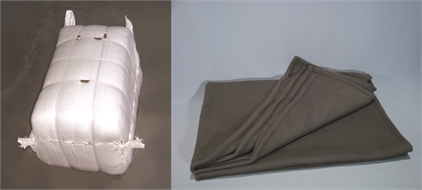
Packing | — Bales to be wrapped in a water-tight micro perforated plastic film and covered with a polypropylene or jute woven bag. — Quantity per bale: 30 pieces. — Compressed and strapped with 5 straps (2 lengthwise, 3 crosswise). — Bales dimensions: Length 85cm +/-5cm, Width 55cm +/-5cm, Height 0.40 cm +/-5 cm (height of the bales to be compressed by maximum 60% from free state to final compressed and strapped state). |
Marking on the blanket | Every blanket should include a tag, stitched in the hem. The tag should include the manufacturer’s name, a unique reference batch number and the date of manufacturing. No company logo should be included with the manufacturer’s marking. |
Marking on the package | BLANKET, SYNTHETIC, 1.5x2m, low thermal – 20 pieces. Other markings as specified in contract. |
HSHEBLANPMT1 | BLANKET, SYNTHETIC, 1.5x2m, medium thermal |
Samples for testing purpose | Samples of blankets must be from compressed bales. All criteria to be passed on the same sample. (Samples of compressed bales to be prepared with only 5 blankets folded once more than in normal bales, at 60% compression ratio, and to remain compressed for one week minimum before testing). |
Make | Knitted or woven, dry raised both sides. |
Content ISO 1833 on dry weight | 100% virgin polyester and/or acrylic fibres or polyester/cotton |
Colours | Other than black, red, or white, dark uniform colour. |
Size | 150 x 200cm +3%/-1%. To be taken on flat stabilised sample, without folds. |
Weight | 400g/m2 minimum maximum 700g/m² weight determined by total weight/total surface. |
Thickness ISO 5084 | 6.5mm minimum (1KPa on 2000mm²) |
Tensile strength ISO13934-1 | 250N warp and weft minimum |
Tensile strength loss after washing ISO13934-1 and ISO 6330 | Maximum 5% warp and weft after 3 consecutive machine washing at 30°C and one flat drying. |
Shrinkage maxi. ISO 6330 | Maximum 5% warp and weft after 3 consecutive machine washing at 30°C and one flat drying. |
Weight loss after washing | Maximum 5% after 3 consecutive machine washing at 30°C and one flat drying. |
Thermal resistance ISO 11092 | Rct= 0.25m².K/W minimum, rounded to the nearest 0.01, passed on samples picked from compressed bales. Mechanical conditioning: after opening of the bale, the blanket shall be dry tumbled in a dryer (500l minimum capacity) without any other load for 15 minutes at a temperature of less than 30°C. Then, the blanket shall be conditioned for at least 24 hours by flat lying at ambient conditions (20°C and 65% Relative Humidity). |
Resistance to air flow ISO9237 under 100Pa pressure drop | Maximum 1000 L/m²/s |
Finish | Whipped seam at 10mm from the edge with 10 to 13 stitches/10cm or stitched ribbon or hemmed on 4 sides. Corners can be round up to 10cm radius, or square. |
Organoleptic test | No bad smell, not irritating to the skin, no dust. 4<,pH<,9. Free from harmful VOC (Volatile Organic Components). Fit for human use. |
Fire resistance ISO12952-1 | Resistance to cigarette — No ignition |
Fire resistance ISO12952-2 | Resistance to flame — No ignition |
Primary packing | — No individual packing of the blanket, in order to reduce plastic wastes in the environment. |
Packing | — Bales to be wrapped in a water-tight micro perforated plastic film and covered with a polypropylene or jute woven bag. — Quantity per bale: 20 pieces. — Compressed and strapped with 5 straps (2 lengthwise, 3 crosswise). — Bales dimensions: Length 85cm +/-5cm, Width 55cm +/-5cm, Height 70 cm +/-5 cm (height of the bales to be compressed by maximum 60% from free state to final compressed and strapped state). |
Marking on the blanket | Every blanket should include a tag, stitched in the hem. The tag should include the manufacturer’s name, a unique reference batch number and the date of manufacturing. No company logo should be included with the manufacturer’s marking. |
Marking on the package | BLANKET, SYNTHETIC, 1.5x2m, medium thermal – 20 pieces. Other markings as specified in contract. |
Specifications
HSHEBLANPHT1 | BLANKET, SYNTHETIC, 1.5x2m, high thermal |
Samples for testing purpose | Samples of blankets must be from compressed bales. All criteria to be passed on the same sample. (Samples of compressed bales to be prepared with only 5 blankets folded once more than in normal bales, at 60% compression ratio, and to remain compressed for one week minimum before testing). |
Make | Knitted or woven, dry raised both sides. If any, inner layer can be non-woven type. |
Content ISO 1833 on dry weight | 100% pure polyester and/or acrylic fibres or polyester/cotton |
Colours | Other than black, red, or white, dark uniform colour. |