| Concentration | |
| Enzyme Applications | - To obtain efficient deglycosylation of glycoprotein substrates under nondenaturing conditions, it is necessary to use a higher starting concentration of enzyme. N-Glycanase-plus and ULTRA (EDTA-Free) are supplied at = 10 U/ml, and are recommended for all applications requiring deglycosylation of glycoproteins in the absence of denaturants. The high activity also allows smaller reaction volumes and shorter reaction times to be explored.
|
| Enzyme Formulation | - 20 mM Tris HCl pH 7.5, containing 1 mM EDTA and 50 mM NaCl
|
| Enzyme Source | - Recombinant gene from Elizabethkingia meningoseptica, expressed in E. coli. The source organism was previously known as Chryseobacterium [Flavobacterium] meningosepticum. Enzyme also known as PNGase F, peptide-N-glycosidase F, peptide-N4-(N-acetyl—glucosaminyl)asparagine amidase.
|
| Enzyme Specific Activity | |
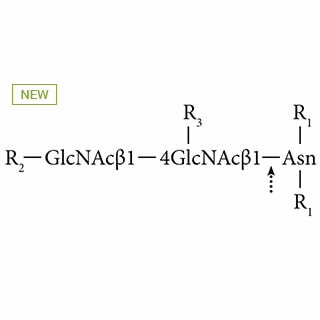
| Enzyme Specificity | - Cleaves all N-linked complex, hybrid or high mannose oligosaccharides, unless a(1-3) core fucosylated, as in plant glycans. Asparagine must be peptide bonded at both termini. Phosphate, sulfate, and sialic acid groups attached to the oligosaccharide do not affect cleavage. Endo F free. Highly concentrated, is useful for deglycosylation under native conditions.
|
| Enzyme Unit Definition | - One unit is defined as the amount of enzyme required to catalyze the release of N-linked oligosaccharides from 1 mole of denatured ribonuclease B per minute at pH 7.5 and 37C.
|
| Unit | |
| Volume | |
| pH Optimum | |
| pH Range | |